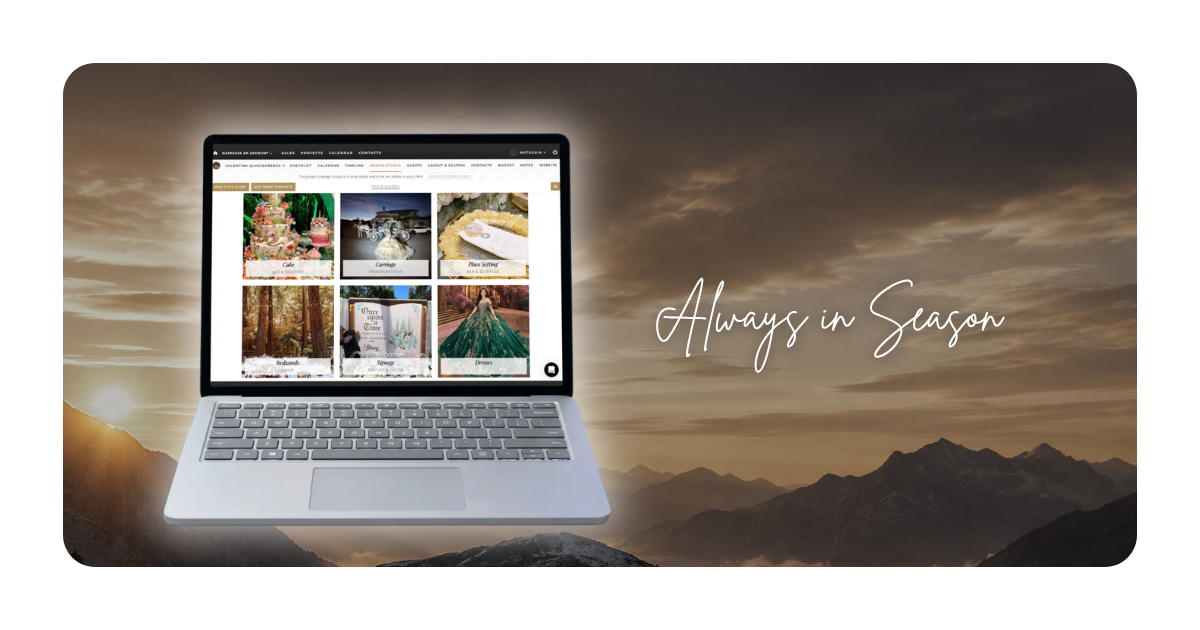
Always in Season
The Seasons Pros are Facing and How to Handle Them.
📖 Read Time:
📅 Date:
The event industry has never been defined by its easiest seasons.
It has always been defined by the people who choose to keep creating through them.
The calendar says there are four seasons.
Event professionals know better.
There’s booking season. Busy season. The stretch when every Saturday is spoken for and your inbox somehow fills faster than you can clear it. There’s the season when business is booming, the season when things finally quiet down and the season when you look at everything you’ve built and wonder what comes next.
Then there are the seasons no calendar can predict.
The year you hire your first team member. The month inquiries suddenly slow down. The stretch when your business grows faster than your systems can keep up. The moment you realize the way you’ve always done things isn’t necessarily the way you want to do them anymore.
That’s the reality of building an event planning business. Whether you’re an event planner, wedding planner, caterer, florist, venue, designer, DJ or rental professional, the work changes. The market changes. Your clients change. And sometimes, you change too.
The goal isn’t to stay in one season forever. It’s to build an event business with the systems, flexibility and confidence to move with you through all of them.
That’s what it means to be Always in Season.
What Does “Always in Season” Mean for Event Professionals?
Being Always in Season doesn’t mean having a calendar maxed out 365 days a year. It means building a business that can adapt to busy seasons, booking seasons, periods of event business growth, quieter months and the unexpected changes in between.
That’s also what good event business management should do.
It gives you a stronger foundation for the work happening behind every event: leads, clients, projects, communication, payments, timelines, design, teams and the countless details competing for your attention.
Because there is no universal busy season in the event industry.
A wedding planner may spend spring and fall moving through back-to-back celebrations. A caterer may feel the biggest rush around the holidays. Corporate event planners can see demand shift alongside budgets, conferences and fiscal years. Venues, florists, DJs, rental professionals and production teams each operate according to different rhythms.
Even two event professionals working in the same city can be experiencing completely different seasons.
Your season isn’t determined by the calendar. It’s determined by what your business needs from you right now.
So, what season are you in?
Busy Season: How to Manage a Busy Event Season Without Losing Control
You know the feeling. The alarm goes off early, there’s coffee somewhere and your phone is already buzzing. One client needs a timeline change. A vendor needs confirmation. Someone is asking where the place cards went. Another event is happening tomorrow and somehow you’re already thinking three weekends ahead.
Welcome to the event planner busy season.
Busy season can be exhilarating. It can also expose every crack in your operation.
A process that felt manageable with five clients suddenly becomes impossible with fifteen. The information you were sure you’d remember gets buried beneath the next urgent request. A quick workaround becomes part of your process simply because no one has time to fix it.
If you’ve ever wondered how to prepare for busy season as an event planner, preparation starts long before the calendar fills. Strong event business organization gives you a clear place for information to live, while a repeatable event business workflow gives you a clear way for the work to move forward.
How to Stay Organized as an Event Planner During Busy Season
The answer isn’t necessarily working faster. It’s reducing how much you have to remember in the first place.
Bring your timelines, client communication, contracts, payments, design details and project information into a system you and your team can actually rely on. Use event planning tools to create templates for the work you repeat and processes for the questions that keep coming up.
Look for opportunities where event business automation can handle routine follow-ups, reminders and administrative work. The best systems support event planner productivity by taking repetitive tasks off your plate, not by helping you cram more work into every hour.
This is also where the right event management software matters. Your technology should make your event planning workflow easier to manage, not become another disconnected system demanding your attention.
Because when Saturday arrives, you shouldn’t be digging through six places looking for the latest version of a timeline.
You should be where you belong: in the event.
Booking Season: Client Management Starts Before the Contract
Long before the tables are set and the first guest arrives, there’s another kind of event happening behind the scenes: the inquiry.
Someone found your work. They liked what they saw. Maybe they followed you for six months before finally reaching out. And now they’re sitting in your inbox.
So is another inquiry.
And another.
Meanwhile, you’re onsite.
This is where client management for event planners really begins. Not at kickoff. Not when the contract is signed. At the very first interaction.
Good event planning client management creates a clear path from I’m interested to let’s work together. You know where the lead came from, where the conversation stands, what they need from you and what needs to happen next.
An event planning CRM can help organize leads, conversations and follow-ups so potential clients aren’t disappearing somewhere between your inbox and your next event. But technology is only part of the equation.
The real goal is consistency.
Your prospective client should experience the same level of confidence in your process that they saw in your portfolio. Because before clients experience your work, they experience how it feels to work with you.
Confidence starts long before event day.
Growth Season: How to Grow an Event Planning Business That Can Keep Up
Growth has a funny way of showing you exactly where your business isn’t ready to grow.
The inquiries increase. Your events get bigger. You add a team member, then another. Suddenly, the process that worked perfectly when everything lived in your head becomes the very thing slowing everyone down.
Understanding how to grow an event planning business sustainably means recognizing when your systems need to grow too.
At some point, your business has to stop depending on you remembering everything.
Your team needs to know where things live. Clients need a consistent experience. Processes need to be repeatable. Information needs to be accessible. And your event business tools need to support the business you’re becoming, not just the one you were when you chose them.
This is where event professional software can become part of your growth strategy. The right technology creates consistency across projects and gives your team a shared foundation for the work happening behind them.
If you’re in a growth season, ask yourself one question: If my business doubled tomorrow, what would break first?
Maybe it’s lead management. Maybe it’s communication. Maybe it’s invoicing, onboarding, project organization or your existing event planning software.
Whatever came to mind first, start there.
Event business growth doesn’t require having everything figured out. It requires recognizing when the old way has carried you as far as it can.
How Event Planners Manage Multiple Clients Without Losing the Personal Touch
Every event is personal to the client.
But behind the scenes, you may be managing ten, twenty or even hundreds of active projects across your business.
So how do event planners manage multiple clients without making the experience feel automated or impersonal?
By creating consistency behind the scenes so there is more room for personalization where it actually matters.
Templates can create a reliable starting point. Automated reminders can keep deadlines moving. A central client portal can give everyone access to important information. A clear event planning workflow can help your team understand what has happened, what comes next and who owns it.
Good systems don’t remove the human side of your business.
They protect your time for it.
That distinction matters when evaluating event business software. Technology shouldn’t replace your expertise or the relationships that make your business different. It should handle more of the administrative weight surrounding them.
Slow Season: Turn Quiet Into an Event Business Growth Opportunity
Then suddenly, things get quiet.
Your weekends start opening up. Your inbox slows down. The constant urgency fades.
For event professionals accustomed to measuring momentum by how full the calendar looks, the event planner slow season can feel uncomfortable.
But slower doesn’t mean stuck.
Some of the most important work in an event planning business happens when nobody is watching. Quiet season gives you enough distance to ask what actually worked. Which processes made life easier? Where did clients consistently get confused? What took three hours that should have taken thirty minutes? Which events were actually profitable? What are you absolutely not doing that way again?
Use the space to strengthen your event business organization. Refresh your portfolio. Revisit pricing. Clean up client files. Update templates. Strengthen vendor relationships. Review your contracts and workflows.
It’s also a smart time to evaluate your event planning tools, wedding planning software and other technology. Are you using everything you’re paying for? Are multiple tools doing the same job? Is information scattered across platforms? Could a better system simplify the way your team works?
And give yourself permission to rest.
Not every open space on the calendar needs to become another project.
Quiet isn’t the opposite of progress.
Sometimes it’s where progress begins.
Change Season: Event Industry Trends Will Change. Your Foundation Should Be Ready.
The event industry has never been particularly interested in standing still.
Styles change. Client expectations evolve. New technology arrives. Markets shift. The way people discover, book and communicate with event professionals changes right along with them.
Keeping up with event industry trends matters, but adaptability doesn’t mean chasing every new platform, feature or idea that appears.
It means knowing your business well enough to understand what deserves your attention.
Maybe clients expect a smoother digital experience. Maybe your team needs better access to information. Maybe you’ve added services your original systems were never designed to handle. Maybe the event management software or wedding planning software that worked when you started simply doesn’t fit where you’re going anymore.
Change isn’t proof that you got something wrong.
Sometimes it’s proof that you’ve grown.
The strongest event businesses don’t abandon who they are every time the industry shifts. They know what should remain consistent and what needs permission to evolve.
You Season: Work-Life Balance for Event Professionals Matters, Too
Somewhere between timelines, contracts, site visits, tastings, load-ins, breakdowns and Monday-morning follow-ups, there’s a person behind the business.
You.
And there will be seasons when life needs more of you.
Maybe you want to travel. Maybe your family needs your attention. Maybe you’re building something outside of your business. Maybe you simply need a weekend that belongs to you.
Event professional burnout is one of the realities of an industry built around weekends, long hours and high expectations. Creating better work-life balance for event professionals doesn’t mean pretending the work isn’t demanding. It means building a business that doesn’t require your constant presence to keep moving.
That’s why systems matter. That’s why boundaries matter. That’s why event planner productivity shouldn’t be measured by how much you can squeeze into a day.
The goal of better systems isn’t to make room for more work.
It’s to make room for more life.
Set communication expectations. Build repeatable processes. Let automation handle what doesn’t require your personal attention. Give your team what they need to make decisions confidently. Use technology that allows your business to move when you do.
The office is only where the planning begins.
Your business should be ready to follow you beyond it.
What Is the Best Software for Event Professionals?
There isn’t one universal answer because no two event businesses operate exactly alike.
A wedding planner may need a completely different workflow from a caterer. A growing venue has different priorities than an independent designer. A team producing hundreds of events needs something different from a professional intentionally choosing fewer, higher-touch clients.
The best software for event professionals is the software that supports how your business actually works while giving you room to evolve.
That means looking beyond a feature checklist.
Can your event management software help organize leads and client information? Does it support the way you communicate? Can it simplify timelines, projects, payments and the details behind an event? Does it give your team a reliable place to work? Can it replace disconnected event business tools that are making your workflow more complicated than it needs to be?
Most importantly, does it work alongside you?
That’s where Aisle Planner Pro comes in.
Aisle Planner Pro is event planning software built for the professionals who move this industry forward. From lead management and client communication to timelines, design, payments and the details that keep events moving, it brings the work behind your business together so you can build workflows around the way you work.
Because the right event professional software shouldn’t decide what your season looks like.
It should help you make the most of the one you’re in.
There Is No Perfect Season
Maybe you’re reading this between events with seventeen tabs open. Maybe your calendar is quieter than you’d like. Maybe you’re booking faster than you expected. Maybe you’re hiring, rebuilding, scaling back, starting over or finally taking a little time for yourself.
Wherever you are, resist the urge to believe success exists somewhere in the next season.
After the next booking. After busy season. After you hire someone. After you get organized. After things calm down.
There will always be another event, another client, another change and another version of your business waiting around the corner.
Great event business management isn’t about preparing your business for one perfect set of conditions. It’s about creating the organization, systems and flexibility to keep moving when those conditions inevitably change.
Being ready doesn’t mean knowing exactly what’s coming.
It means building a business capable of meeting you there.
You don’t have to be in your busiest season to be in your best one.
Your business is allowed to change. Your priorities are allowed to change. Your definition of success is allowed to change. The seasons will too.
Wherever they take you, be ready.
Always moving. Always ready. Always in Season.
Being “Always in Season” means building an adaptable business foundation that thrives regardless of calendar fluctuations. Rather than measuring success strictly by peak booking volume, it focuses on using every phase—busy, slow, booking, or transition—to strengthen operations, refine client management, and support sustainable business growth.
Staying organized requires centralizing your business details into one reliable management system rather than relying on memory or scattered tools. Standardizing event workflows, utilizing project templates, and automating administrative follow-ups help reduce decision fatigue and ensure critical timeline details aren’t lost when client volume peaks.
Successful multi-client management relies on backend consistency. By using centralized client portals, standardized communication templates, and structured project milestones, planners handle routine administrative tasks efficiently. This frees up time and energy to focus on high-touch, personal interactions where they matter most.
The slow season is an opportunity for strategic business development. It is the ideal time to overhaul brand assets, refresh website SEO, review contract terms, re-negotiate vendor partnerships, audit pricing models, and evaluate software tools to prepare for the next influx of bookings.
Preventing burnout requires setting operational boundaries and implementing automation. Establishing firm communication hours during onboarding, delegating routine tasks through event management software, and building clear operating procedures allow planners to protect personal time without compromising client expectations.
The best software aligns with your specific workflow, supporting lead tracking, client communication, timelines, floor plans, and financial management within a single platform. Tools like Aisle Planner Pro provide an all-in-one suite designed specifically to streamline backend operations and support long-term business growth.
Aisle Planner Pro combines CRM functionality, client collaboration, proposals, contracts, timelines, payment solutions, design boards, project management, and workflow automation into one platform designed specifically for event professionals. Instead of managing multiple disconnected tools, planners can organize their entire business from one centralized solution.